
AI / POC Lab
Not Just Aware of AI. Using It.
This section documents what I've actually built, working systems applied to real problems. Not demos for the sake of demos. Each project started with a genuine need, got built across multiple sessions, and is either in active use or in progress. The stack varies. The approach is the same: figure out what AI can actually do by building something that has to work.
The engine is built and heavily proven: eight of eleven build blocks complete, 21 proof suites and 393 checks green, re-run twice to show repeatability. Discovery, Strategy and the Go/No-Go pair are producing. The next build is the gate screen where a person makes the call.
- 1DiscoveryA brief goes in; an agent produces a structured brief plus a set of facts, each one declaring whether it is sourced or unverified. Cost is accounted at four rates from the first call.
- 2Review and dissentA reviewer from a different model family iterates the output to a quality bar, with a premise-gated stop that fails closed rather than pushing a weak premise forward.
- 3Opportunity screenThe idea is screened against a per-product cost baseline, so the spend floor for pursuing it is known before anything expensive runs.
- 4Bull and bearTwo agents argue the Go/No-Go — one for, one against — with the database enforcing that they come from different model families.
- 5Sealed packetThe arguments and their evidence are frozen into a tamper-evident packet, so the decision can later be audited against exactly what the human saw.
- 6The human gateA person reads the packet and decides. Nothing irreversible happens without that signature — which is why the gate screen is the next thing being built.
Most senior executives either pay $15K-$30K and wait 6-10 weeks for a professional site, or settle for a generic template that undersells them. The goal was a founder-forward dual-audience site with real content and a live AI/POC Lab - without the agency timeline or cost.
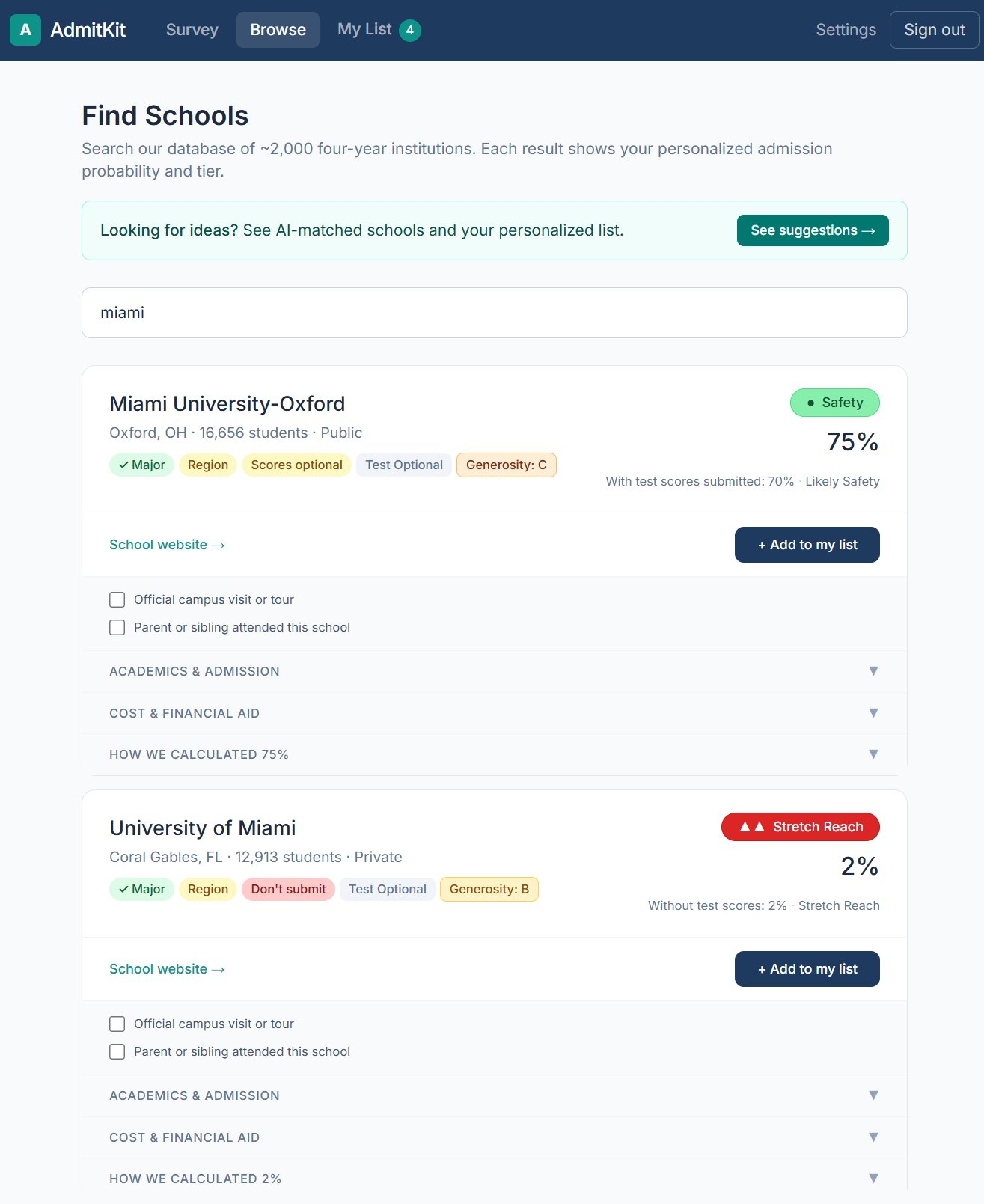
Most families don't know how to build a balanced college list. They navigate with spreadsheets, gut feel, and conflicting advice from counselors. AdmitKit asks the right questions, calculates personalized admission probabilities, surfaces student perspectives from YouTube, and recommends a list balanced across Safety, Target, and Reach schools. The tool that started as a custom build for one family is now a public beta available to every family.
A serious job search has more moving parts than a chat assistant can hold reliably: applications spread across many platforms, recruiter threads, shifting follow-up deadlines, and screening criteria that change from role to role. The first version of this system solved that inside a chat window and then accumulated enough regression that reliability became the real problem. A run could not be trusted to behave the same way twice, and the spreadsheet it wrote to was a synced file that corrupted under concurrent writes. The rebuild treats the search as a data pipeline rather than a conversation, so every stage is inspectable, testable, and repeatable.
- 1Finds new rolesTriages Gmail alert digests, scans a tiered watchlist of career sites, and pulls directly from ATS platforms. Everything is deduplicated against the full history, matched on external job ID or on a normalized company and title pair.
- 2Runs on a scheduleA morning brief fires from a local task scheduler and produces the slice that can honestly run without a human: pipeline counts, a preview of the time rules that never commits, the ranked queue, and follow-ups due. Work that needs a logged-in browser is queued, not skipped silently.
- 3Screens for fitRetrieves the complete posting, scores it, then applies deterministic banding and flags before writing to the database. A partial description is not scored at all: the role is parked as pending review, because a fit number derived from a truncated snippet is worse than no number.
- 4Ranks the queueOrders the apply queue by a stretch-penalized composite that discounts fit by how much of the role sits outside demonstrable experience, tie-broken by freshness and compensation, then split into a capped ready tier and a tier needing one explicit acknowledgement.
- 5Generates documentsProduces a tailored resume and cover letter through a verified-facts gate, a repetition check, an AI-tell linter, and a keyword pass that folds in only terms the evidence inventory can back. Output is checked as rendered PDF, not just as source.
- 6Pre-fills the applicationDetects the ATS, loads the matching adapter, verifies the documents are current, builds a field-level fill plan, then drives the browser to the review page and stops. A static safety invariant makes submit, login, terms, and voluntary disclosure unreachable. Unknown platforms degrade to a packet handoff instead of guessing.
- 7Hands back the dayDrafts a summary of new roles, the ranked queue, follow-ups coming due, and any degradation flags raised during the run. The submission itself stays a human act, recorded afterward through a guarded command that enforces event ordering.
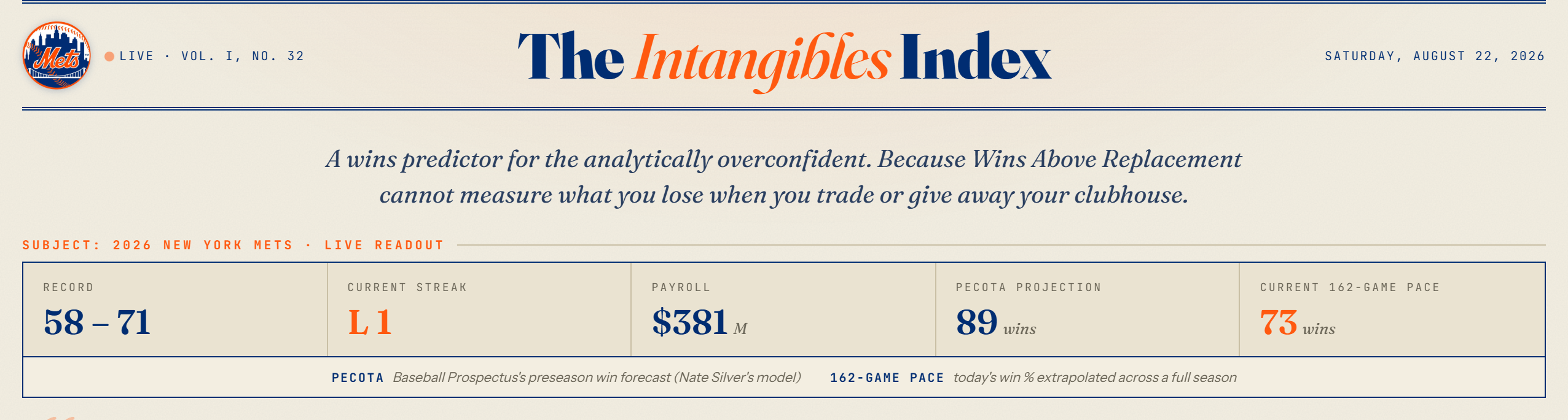
Traditional baseball projections like PECOTA are statistically rigorous and emotionally empty. Fans know a season is not just wins above replacement. It is tabloid drama, mascot charisma, and whether the bullpen can find the strike zone in August. This project puts those variables in the equation.
Phase I complete. Phase II active. Stakeholder intelligence shapes agent decisions and tailors BRD/PRD exports to individual audiences. Seven documented runs across ERP forecasting, e-commerce, athletic training, furniture making, and professional networking, with 100% schema compliance since Round 2. The pipeline adapts naturally to non-software domains without special handling.